The real question behind "WordPress or not"
You need a website. A Google search for "create a website" yields an overwhelming range of options: WordPress, Wix, Squarespace, Webflow, or hiring a freelance developer.
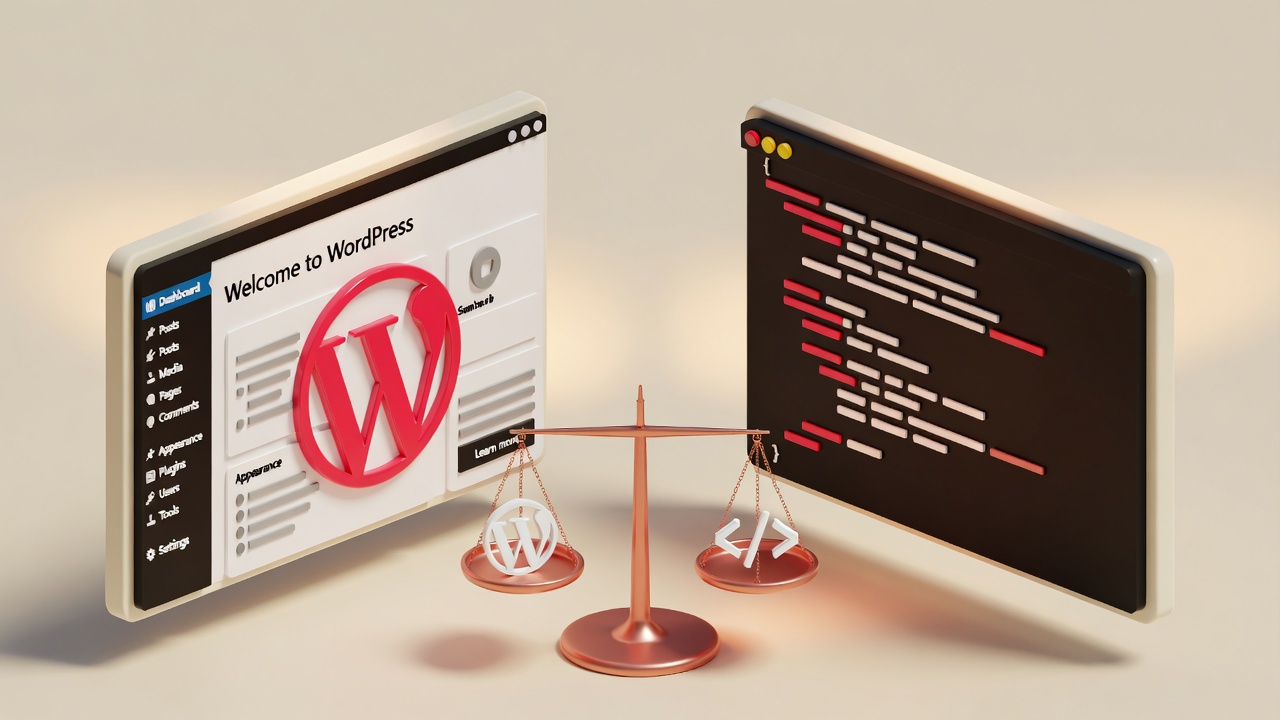
For professional use, two serious options coexist:
- WordPress, the most widely used CMS in the world (43% of the web runs on it)
- Custom development, where a developer codes your site from scratch with a modern framework
Each has strengths and limits. Predictably, WordPress agencies and custom developers each frame the debate in favour of their own offering. The present comparison comes from a developer who works with both on a daily basis, which allows for a less biased evaluation.
WordPress in 2026: actual strengths and limits
WordPress is an open-source, free software that lets you create a website without writing code. You install a theme, add plugins for features, and edit content in a visual editor.
What works well with WordPress
Content management autonomy. This is the main argument and it holds up. Editing text, publishing an article, changing an image does not require touching the code. For a client publishing three articles a week, this is a substantial asset.
A large ecosystem. More than 60,000 plugins available. A contact form, e-commerce via WooCommerce, a booking system: most common features already exist in off-the-shelf form.
Provider availability. WordPress is known to every stakeholder in the sector. If the initial developer becomes unavailable, a replacement can pick up the project without rebuilding from scratch.
A low initial cost. A WordPress site starts around 500 to 1,500 euros with a junior freelancer or a page builder like Elementor or Divi.
The difficulties observed with WordPress clients
Performance. A typical WordPress site with Elementor, around fifteen active plugins and a premium theme shows mobile loading times of three to six seconds. Above 2.5 seconds, Google considers the user experience degraded. In 2026, this is a real handicap for organic ranking.
Security. WordPress is the primary target of attacks precisely because of its ubiquity. Each plugin is a potential entry point. Several client sites have been recovered after being compromised through a plugin that had not been updated for eight months, displaying ads for online casinos.
Plugin dependency. Every feature relies on a plugin, therefore on a third-party developer. That developer can abandon the project, introduce a conflict with another plugin or switch to a paid version. Some sites run more than thirty active plugins. Each major WordPress update then becomes a significant point of attention.
Actual three-year cost of a WordPress site
| Item | Year 1 | Year 2 | Year 3 | Total |
|---|---|---|---|---|
| Creation | 1,500 euros | - | - | 1,500 euros |
| Premium theme | 60 euros | - | - | 60 euros |
| Premium plugins | 200 euros | 200 euros | 200 euros | 600 euros |
| Decent hosting | 150 euros | 150 euros | 150 euros | 450 euros |
| Maintenance and updates | 100 euros | 200 euros | 300 euros | 600 euros |
| Redesign (likely over time) | - | - | 2,000 euros | 2,000 euros |
| Total | 5,210 euros |
Custom development: what this choice actually involves
The developer creates the site from a blank slate by writing code. No predefined theme, no third-party plugins. Every line is written for the project at hand, based on a modern framework such as Nuxt.js, Next.js or Laravel.
The advantages observed daily
Performance. A well-built custom site loads in under a second. No unnecessary code, no superfluous scripts loaded preventively. The effects on ranking and time on site are measurable.
Security. Without third-party plugins, there is no known vulnerability exploitable at scale. The site does not depend on an external ecosystem requiring constant surveillance.
Scalability. A specific business feature (CRM, API, payment system, advanced multi-language) is built into the project architecture, without workarounds.
Lifespan. A well-designed site with a modern framework holds up for five to seven years without a rebuild. Updates are incremental.
Code ownership. The code is versioned on Git, documented and portable. Changing providers does not require rebuilding everything.
The limits to bear in mind
Higher initial cost. A custom showcase site starts between 1,500 and 3,000 euros, roughly double a basic WordPress site.
Content editing is less direct. Editing text autonomously is not as immediate as with WordPress. Integrating a headless CMS (Strapi, Sanity, or Notion used as a back-office) remains possible at the cost of added complexity.
A smaller provider pool. A Nuxt.js or Vue.js site is less common than a WordPress site. A replacement developer can be found, but the search takes more time.
Actual three-year cost of a custom site
| Item | Year 1 | Year 2 | Year 3 | Total |
|---|---|---|---|---|
| Creation | 3,000 euros | - | - | 3,000 euros |
| Hosting | 100 euros | 100 euros | 100 euros | 300 euros |
| Maintenance | 0 euros | 200 euros | 200 euros | 400 euros |
| Occasional improvements | - | 500 euros | 500 euros | 1,000 euros |
| Total | 4,700 euros |
Over three years, custom development ends up less expensive than an equivalent WordPress setup. This is not a sales argument, simply the result of the calculation.
WordPress versus custom development comparison
| Criterion | WordPress | Custom |
|---|---|---|
| Initial cost | 500 to 2,000 euros | 1,500 to 6,000 euros |
| Total cost over 3 years | 4,000 to 7,000 euros | 3,500 to 6,000 euros |
| Loading speed | 2 to 6 seconds | Under 1 second |
| SEO | Decent with plugins | Excellent natively |
| Security | Average, depends on updates | High |
| Content autonomy | Excellent | Limited unless headless CMS |
| Customisation | Limited by themes and plugins | Unlimited |
| Scalability | Average | Excellent |
| Provider switch | Easy | Moderate |
Recommendation after seven years of freelance practice
WordPress remains the right choice when:
- The budget is under 1,500 euros
- The client publishes content regularly and wants to manage it alone (blog, news)
- The site stays simple: fewer than five pages, no specific business features
- The client accepts dedicating time to maintenance and updates
Custom development becomes preferable when:
- The budget exceeds 2,000 euros
- Performance and organic ranking are strategic for the business
- Specific business needs are present: CRM, multi-language, API, online payments
- The client expects a lifespan of five years or more without a major rebuild
- The result must differ from the standard output of the sector
The decision is not purely technical, it is strategic. The central question is: what role should the site play for the business? The technical implications follow.
Unsure between the two approaches? Get in touch to discuss it. Direction will be given based on the actual need, including when the answer is "WordPress is enough in your case".