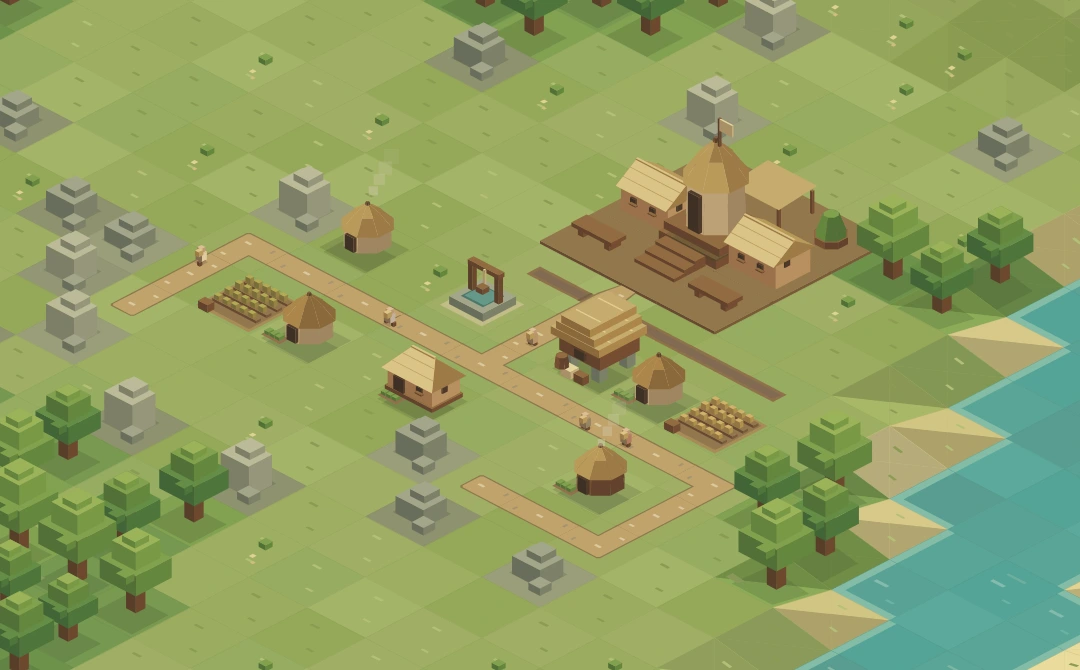
DelTown grew enough food for 126 people a day and had homes for 120. The population counter sat at 96. Before changing how quickly people moved in, I asked Codex to look at my save and find out what was keeping them away. On a copy of the town, one extra well did the trick. Three game days later, DelTown had 102 residents.
That explained the missing residents. It also left me with a slightly embarrassing design problem. I had to open a chat to understand my own game. That playtest gave CraftAges its town council. Players can now see what is holding back new arrivals and decide what to build next.
Take one village from stone to bronze
I spent hours playing the original SimCity. Years later, after an afternoon playing SlopCity, I wanted that kind of city management in a browser, with something I loved about Civilization. What would become of my first village if I kept it for centuries?
BlokCity, as I called CraftAges then, started as a single HTML file I could open in Firefox. Neighbouring maps could wait. My first playtest took up a handful of tiles. I built a workshop, reached the Bronze Age and upgraded a house on its original plot. Reloading the page had to bring that house back. Once I could play through that transition, I wanted to try iron.
The game now spans ten ages, from the first camps to the future. In Story mode, research, supplies and public works determine when you advance. Free mode lets you put an industrial district next to stone houses from day one. In City, you can found neighbouring towns and trade between them. Empire adds garrisons, diplomacy and battles, with computer-controlled neighbours in solo play or other mayors in multiplayer.
Move the game to Nuxt and keep the town
As the prototype grew, I split the move to Nuxt into milestones. The first was to extract the simulation into TypeScript. Codex compared 305 calls to the old and new engines on the same run from stone to iron production. The resulting states matched. The next step was moving the menus into Vue components while keeping the map on Canvas 2D and retaining local saves.
My acceptance test for the new Nitro server and MariaDB database was a single road tile. Suppose the town had been saved, but the browser lost the response. What would the next attempt cost? The test dropped the response, reloaded the page and counted the wood. One road tile on the ground, one unit of wood spent. Player accounts and resuming on another device came in the following milestone.
Twenty-one workshops when the town needs twenty
In another save, KanaTown, the industrial demand gauge read −100%. Going by that figure, I would have stopped laying out industrial districts altogether. The town had 21 workshops and needed 20. After a change to the calculation, the same surplus showed up as −5%. The extra workshop was still there. Now I could judge how much it mattered.
That kind of discrepancy changed the way I wrote requests. I start with the number on the screen, the decision it points me towards and the detail on the map that makes me doubt it. Codex can check the formula on a copy, run a few days and give me the same situation to examine again. KanaTown already had all the buildings it needed for that test.
Give the player a decision about copper
Playing Factorio made me want to follow a shipment through the streets. In the first experiment, a carrier walked from a copper mine to a workshop. Adding a single road tile on the test map cut the route from seven tiles to three. I liked watching the carrier take the shortcut. Once the road was in place, though, there was little left for me to decide.
I asked to try three delivery lines on a copy of KanaTown. The first takes ore to a workshop, where researchers turn it into study notes. The second takes those notes to the House of Knowledge to be bound into a book. The third delivers the book to the town hall. In Story mode, the knowledge point is awarded when the book arrives. Players choose each route and assign its carriers. Sending someone to the smelter now has a consequence for the workshop waiting for its next delivery.
Playing again exposed a missing question in the menu. Where is my stock? Twenty bars at the smelter and twenty bars available at the town hall mean different things when you want to build. The logistics panel now opens with stock by building, goods in transit and carrier assignments. Select a route and you can find its carrier on the map.
I sometimes kept two Codex chats open on the same town. One was changing how water worked while the other prepared the first copper route. I told each chat what was happening in the other. The first delivery worked in a solo City game in Story mode. When I asked why I had to pick that particular combination, we found a restriction I had never intended. I had the route extended to Empire and multiplayer.
Play the same town again
To review the final three ages, I asked to see the same harbour district from the same camera angle. Keeping the plots in place let me compare a façade, a vehicle or a boat across eras. A save does much the same job when I’m checking a rule. It gives me something familiar to return to and a way to see what the change feels like to play.
If you visit a town, try following a road from the first few houses to a workshop. Those short stretches of road have given me a surprising number of things to work on. Explore the public towns · View the CraftAges project